Updated, April 30, 2025
Information for Health Care Providers on Injuries Related to Off-Road Vehicle Use
Off-road vehicles (ORVs) are motorized vehicles designed to handle rough terrain. They include all-terrain vehicles (ATVs) and side-by-sides (SxSs), which can be either a utility terrain vehicle (UTV) or recreational off-highway vehicle (ROV) (See figure 1).
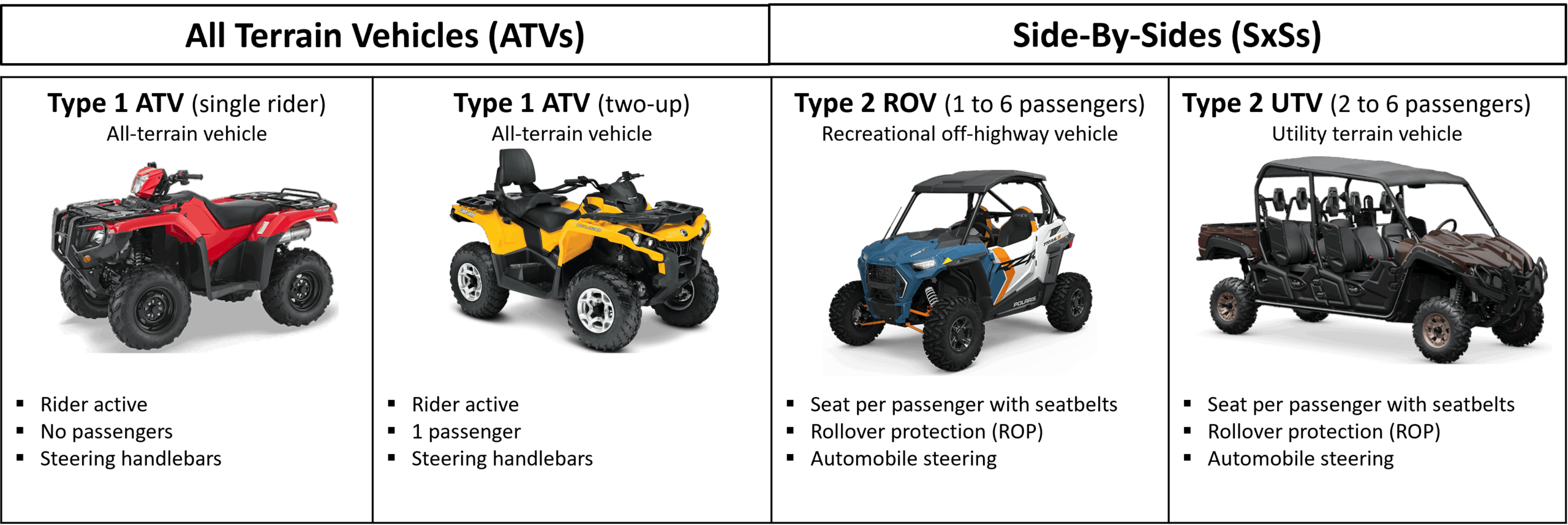
Source: Wayne Daub, General Manager, Canadian Quad Council
Children and adolescents use ORVs primarily for recreation although it has been used for occupational purpose in agricultural settings or transportation for cultural and land-based activities in First Nation, Inuit and Métis communities.
ORV use is strongly associated with severe injuries in children and adolescents. Between 2012 and 2022, an average of 537 hospitalizations and 20 deaths per year have occurred in children and adolescents due to ORV use. ATV fatalities in older adolescents are related primarily to rollovers, while vehicle ejection is more common among younger children because they are frequently positioned as passengers (The Canadian Paediatric Society, 2025).
The Canadian Paediatric Society recently published a statement on strategies to prevent injuries from ORV use. For health care providers, strategies include:
- Educating families about the significant risks for severe injury and death in children and adolescents due to ORV use regardless of ORV model or adult supervision
- Counseling on safer practices such as use of a helmet and protective gear, avoiding paved or compacted roads, riding as a passenger only on vehicles manufactured to carry passengers and checking that vehicle-equipped safety equipment are being used properly.
For more information, please read The Canadian Paediatric Society’s 2025 Position Statement.
For information that can be shared with parents and families, check out this resource: Are off-road vehicles safe for children and youth? | Caring for kids
For more about strategies on preventing falls from off-road vehicles read:
- Off-road vehicle (ORV) and all-terrain vehicle (ATV) safety from Toronto SickKids.