
Try the hearWHO app for free hearing screening.
Finding hearing problems early helps make treatment easier. In order to ensure that hearing loss is noticed as early as possible, all people should check their hearing from time to time, especially those who are at a higher risk of hearing loss. They include people who often listen to loud music, work in noisy places, use medicines that are harmful to hearing, or who are above 60 years old (World Health Organization, 2025).
Helpful guidance from the World Health Organization:
- All adults, from the age of 50 years should be screened regularly for hearing loss. Screening may be conducted at 5-yearly intervals until the age of 64 years.
- From 65 years of age, the frequency of screening should be increased to every 1–3 years.
- Wherever possible, hearing screening schedules should align with other health checks.
What Does Hearing Loss Have to do With Falls?
By: Marilyn Sitar, Wellness Facilitator, Manitoba Interlake-Eastern Regional Health Authority

Hearing loss is surprisingly common!
Whether due to aging or other factors, 60% of Canadians aged 19-79 have a hearing health problem! (i.e., Hearing loss and/or tinnitus). (1) Hearing loss can impact our ability to communicate with others, our social interactions, mental well-being, and cognition.
But, DYK, hearing loss (for both children and adults) is also associated with an increased risk of falls?! (2,3,4,5, 6)
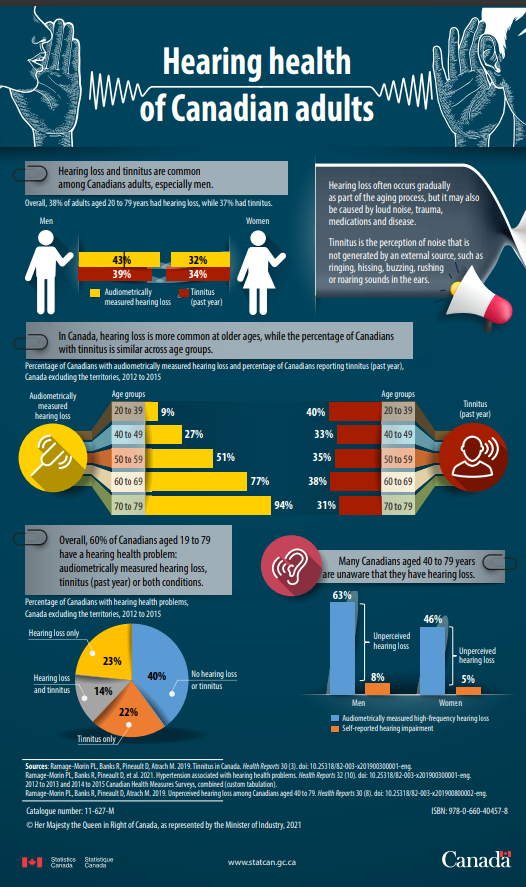
Click on image to view.
The connection between hearing loss and falls is not well understood. However, there are many theories!
- Hearing loss may be connected to our vestibular system and balance. (7)
- Hearing loss may result in a reduction in one’s awareness of their environment (i.e. missing important auditory cues). (7)
- Hearing loss may even affect our ability to “echolocate” (to gather information) about our surroundings by hearing sound or echoes bouncing off surfaces). (8)
Whatever the reason, it is important to know there are resources available to help you take steps to check, correct or improve your hearing:
Free hearing screening apps
- hearWHO
- Hearing Number app for iOS or Android
Note: These apps are not a replacement for a hearing test with an audiologist rather, they are just a starting point to give you an indication of whether hearing loss may be a concern for you.
Free Hearing Test (IERHA Audiology Department)
- The IERHA audiology department has 2 locations in our region – Beausejour and Selkirk – where you can access a free hearing test, covered by Manitoba Health. Referrals are accepted from all sources, including health professionals, schools and individuals.
- Simply request a referral from your doctor or fill out the form yourself. Select the correct form – (FORM FOR ADULTS / FORM FOR CHILDREN) and fax or mail it to the audiology program. For those without access to a fax machine, the form can be mailed to one of the addresses noted on the IERHA website.
- For children who have a hearing deficit, hearing aids are fitted and provided at no cost through this program. For adults, however, the cost of hearing aids not covered. From here, you can go to a hearing aid provider of your choice. (Please see the next two programs listed below, which may help offset costs).
Disability Tax Credit (DTC)
- If you have severe or profound hearing loss, the DTC may offset some of the costs related to the impairment by reducing the amount of income tax you may have to pay.
Manitoba Seniors Hearing Aid Program
- Provides up to $2,000 every 5 years towards the purchase of hearing aids and hearing assessment for eligible Manitoba residents.
- Note that while wearing corrective hearing aids can reduce your risk of falls, consistency is key! One study found that hearing aid users who wore hearing aids for at least four hours a day reduced their chances of falling by up to 65%! (8)

Why the focus on falls?
Well, falls continue to be a serious public health issue.
Between 2008 – 2020:
- The annual number of fall-related hospitalizations among older adults increased by 47%.
- 87% of the injury-related hospitalizations in Canada were due to falls (excluding Quebec).
Yes, falls are a serious concern, but do not lose heart! Getting your hearing assessed and wearing hearing aids to correct hearing loss are just two of the many steps you can take to reduce your risk of falls and prevent a potentially serious injury.
References:
- Hearing health of Canadian adults.
- Implementing hearing and vision health strategies.
- The Hidden Risks of Hearing Loss | Johns Hopkins Medicine.
- SAC Info Sheet – Hearing Loss Increases the Risk of Falls.
- SAC Info Sheet – Hearing Loss Increases a Child’s Risk of Balance Problems.
- Children With Hearing Loss and Increased Risk of Injury – PMC.
- Hearing Loss and Falls Among Older Adults in the United States – PMC.
- Wearing hearing aids may reduce the risk of falls in older adults: Shots – Health News: NPR.
- Noise and sound: Hearing loss and tinnitus – Canada.ca.
- Temporal-trends-characteristics-fall-related-deaths-hospitalizations-emergency-department-visits-older-adults-canada.pdf
For more information visit: Vision and Hearing.