
Here are some ways you can take the lead in preventing playground injuries.
PROVIDE SAFE PLAY SPACES THAT MEET THE CSA STANDARD
The Canadian Standards Association (CSA) publishes voluntary playground standards for outdoor public play spaces. This is considered the “gold standard” for public playgrounds. For more information visit:
- The Canadian Standards Association (CSA) to purchase a copy of CAN/CSA Z614 “Children’s Playspaces and Equipment”
- The Manitoba School Board Association for an online copy of Public Playground Safety: An information guide for schools, daycares and municipalities. This resource discusses playground design and the CSA guidelines.
INSPECT YOUR PLAYGROUND REGULARLY
- Have equipment and play spaces inspected by a certified playground inspector. Visit Canadian Playground Safety Institute for a list of certified playground inspectors.
- Regularly inspect your playground, looking for hazards, such as worn surfacing or broken equipment. The Manitoba School Boards Association’s Risk Management at a Glance: Forms has a Monthly Playground Maintenance Inspection Report, a Play Space Inspection Report and a Weekly Playground Inspection Checklist.
- Replenish surfacing and repair or replace broken equipment as soon as possible to prevent injuries.
- Report any injuries that occur on public play equipment to Health Canada. The Hazardous Products Act requires that all injuries related to consumer products be reported.
DESIGN CLIMATE AND HEAT-READY PLAYGROUNDS
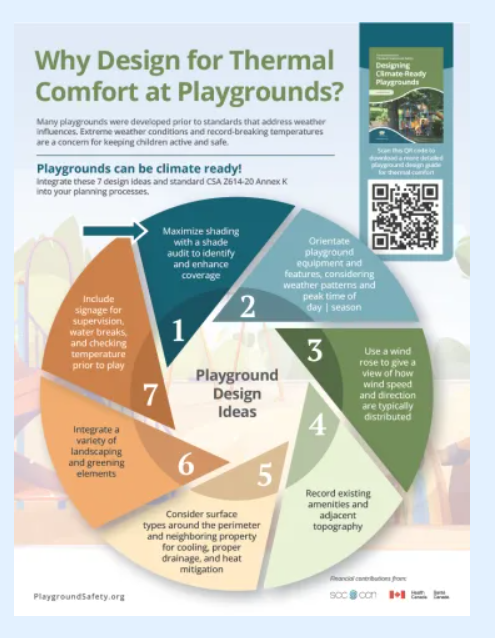
Extreme heat can turn playgrounds into micro heat islands, posing substantial risk to the safety and comfort of children during warm seasons. New guidance and assessment tools have become available for achieving thermally comfortable and safe playgrounds. The materials below were developed by Dr. Heather Olsen at the National Program For Play Area Safety, with support from the Standards Council of Canada and Health Canada. Resources were developed to inform planners, playground designers and equipment manufacturers, educators, playground operators, insurance agencies, and community members – on how to design thermally comfortable playgrounds for all seasons, including during the warm summer months:
- A how-to guide: Fundamentals for Thermal Comfort and Safety: Designing Climate-Ready Playgrounds
- The information is applicable for planners, educators, directors, owners and operators (such as child care and school facilities; municipalities and parks; and community housing), designers, landscape architects, playground equipment and surfacing installers, insurance agencies, civic organizations, parents, grandparents, community members, and other youth organizations.
- Assessment tools: “Does your playground make the grade?” and “Playground Report Card”
- Infographics: Why design for thermal comfort at playgrounds? AND Stay cool while playing
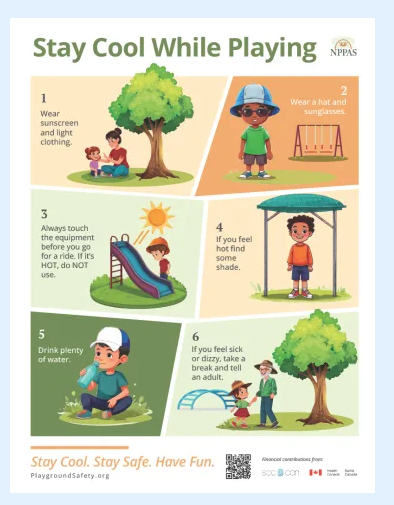
Stay Cool. Stay Safe. Have Fun. Playgroundsafety.org
Click on images to increase size.
HELP SPREAD THE WORD ABOUT PLAYGROUND SAFETY
Many serious injuries at playgrounds can be prevented by adult supervision and smart choices. You can help be a community playground advocate by:
- Educating parents – Kids Don’t Bounce Playground Safety
- Educating day cares, community centres, schools and other groups with playgrounds – Kids Don’t Bounce Community Action Guide
- Using these key playground safety messages in media communications and newsletters:
- Supervise young children
- Select age-appropriate equipment
- Check for soft surfacing
- Teach your children playground rules
- Report safety concerns
- Consider natural alternatives
PROMOTE TRAINING FOR INSPECTORS, OPERATORS AND SUPERVISORS
The Canadian Parks and Recreation Association’s Canadian Playground Safety Institute offers of several online and in-classroom courses on playground safety. Courses are based on the CAN/CSA Children’s Playspaces and Equipment Standards. Courses include:
- Theory (Certification – part 1 of 2)
- Practical (Certification – part 2 of 2)
- Managing Safe Playspaces (non-certification course)
- Accessibility (non-certification course)
- Playground Inspector re-certification
